Study in Korea without guessing what comes next.
Everything you need to go from choosing a university to arriving in Korea: the real costs, every document, every deadline, the visa, and the tools that keep it all on track. One purchase. Lifetime updates. No subscriptions.
$59 · one payment · no subscription
Why applications really fail
Students don't fail because they aren't qualified. They fail because they miss something small.
A record 253,400 international students were enrolled in Korean universities as of April 2025 (Ministry of Education data). Getting in is absolutely doable. What sinks applications is rarely grades. It is the small, mechanical things nobody warns you about:
The missing apostille
Korea University's guide is blunt: submit the original apostilled transcript late and you are disqualified. Legalization can take six weeks, and it cannot be rushed from abroad.
A bank balance on the wrong date
The visa process wants the money seasoned in the account by a specific date, not just present on the day you print the statement.
A deadline in portal number five
Five universities means five separate portals, five document sets, and five deadlines. One forgotten login can cost a whole intake.
The wrong stamp on the right document
Notarized is not apostilled, and apostilled is not consular-legalized. Order the wrong one for your country and you wait weeks to redo it.
Last year's requirements
Fees, forms, and visa rules change every cycle. A blog post from last year can quietly point you at documents your university no longer accepts.
None of this means you are not good enough. It means doing it alone is expensive: weeks lost redoing paperwork, non-refundable fees paid twice, or a missed intake and half a year of waiting.
The KoreaAdmit Framework
Six steps from decision to arrival.
Everything in the Master Plan hangs on one ordered path, and the Journey Planner dates it around your intake, so you always know what this month is for. Each step below names the modules that carry it.
- 1
Choose the right universities
M1 · M5Find the schools that fit your grades, your budget, and your goals. Check whether your exact program needs Korean before you shortlist, and dodge the English-taught trap.
- 2
Calculate your real costs
M2 · M3Tuition, housing, insurance, flights, and the fees people forget, in one honest all-in number. Then the exact bank balance to show for the visa, and the date to show it.
- 3
Prepare every required document
M4Know exactly which documents you need, how to legalize them for your country, and the day to start so the paperwork never stalls you.
- 4
Assemble a submission-ready application
M9 · M6Build every piece from templates and a worked example: the study plan, the emails to admissions offices, the file checklist. You never start from a blank page.
- 5
Submit before every deadline
M6 · M9Every university, portal, fee, and date in one tracker, with a deadline calendar counted back for you, so nothing slips.
- 6
Get your visa and move to Korea
M7 · M8The COA to D-2 sequence in the right order with realistic waits. Then arrival: the ARC, a bank account, a SIM, housing, and insurance, without a second scramble.
What's inside
Real tools that do the work.
Ten working tools inside your account, not PDFs to print. Two of them you can try free right now, before you pay anything.

Total Cost Calculator
Know your real all-in number before you commit: tuition, living by city, and the fees people forget.
Try it free →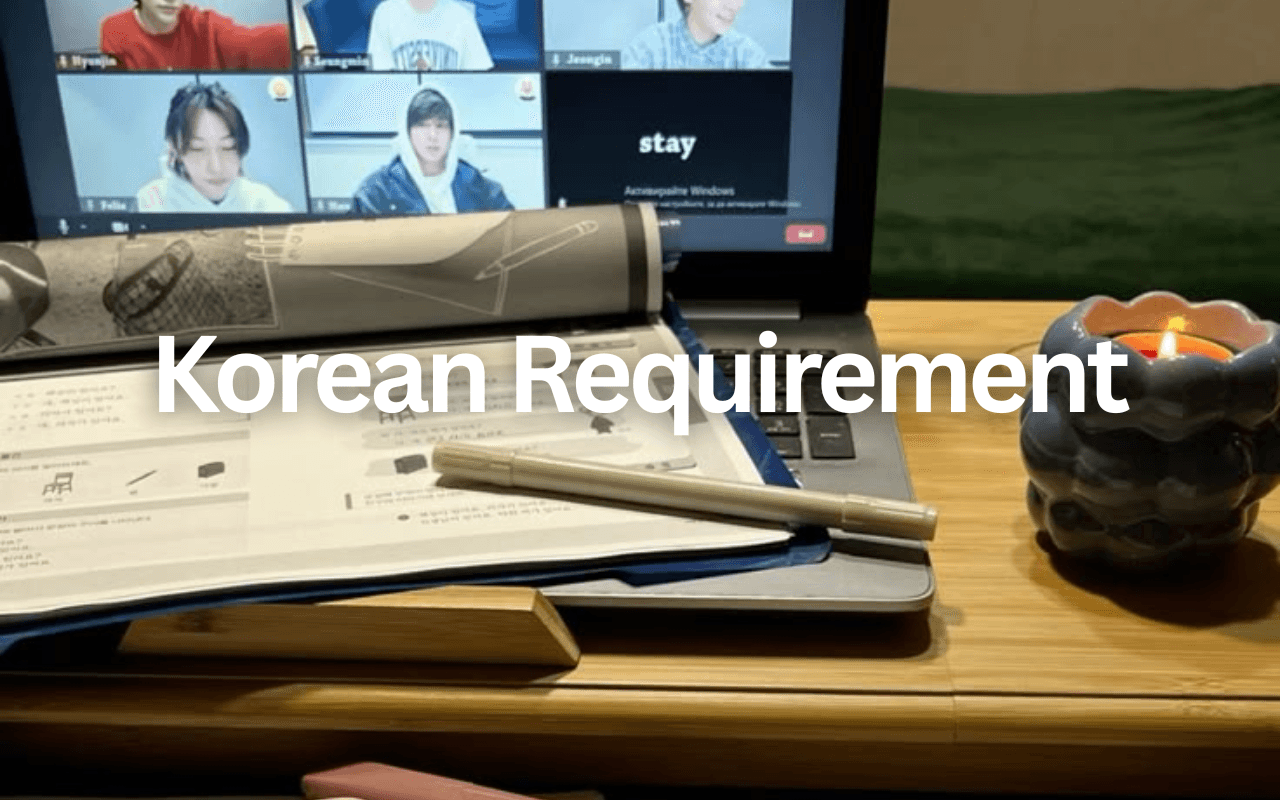
Korean Requirement Checker
Know whether your exact program needs Korean, and what level, before you build a shortlist around a guess.

Language School Chooser
If Korean comes first, compare university language institutes on cost, terms, and admission benefits.

How Much to Show in the Bank
Walk into the visa appointment knowing the exact balance your consulate wants to see.

Bank Balance Planner
Get the money into the account by the date it has to be seasoned, not in a scramble the week before.

When to Start
Never begin the paperwork too late: a reverse timeline from your deadline back to day one.
Try it free →
Get My Documents Legalized
Never redo a document: apostille or legalization steps for your country, in the right order.

Application Tracker
Never lose a deadline in portal number five: every university, fee, and status in one view.

Deadline Calendar
Know exactly what to do every month between today and arrival, counted back for you.

Document Templates
Write the study plan and the emails with confidence, from templates and a worked example.
And the ten modules they live in.
M0
Start here
The order to do things in, the Journey Planner that dates your route (straight in, or language school first), and a note from me.
M1
Where you can get in, and afford
An honest map of the tiers, the English-taught vs English-track trap, and a simple reach / target / safety shortlist tied to the live university directory.
M2
What it really costs
The Total Cost Calculator: tuition, living by city, and the one-time fees most budgets miss, in one honest number.
M3
How much money to show
How Much to Show in the Bank, plus the Bank Balance Planner that gives you the exact date the money has to be in the account so it is seasoned in time.
M4
Getting your documents legalized
Apostille, notarization, and legalization in plain words, Get My Documents Legalized steps by country, and When to Start so the paperwork never stalls you.
M5
Korean, tests, and language school
Whether to study Korean first: the language-school year on a D-4, the university institute comparison, the per-university Korean requirement checker, and how to time TOPIK or IELTS so scores land in time.
M6
Applying, and keeping track
The reality that every university is its own portal, the Application Tracker with a fee budget, and email templates for admissions offices.
M7
The student visa (D-2)
The COA, visa, consulate order with realistic waits, the TB-test flag, D-2 vs D-4, and a checklist you can just follow.
M8
After you land
The alien registration card within 90 days, banking, a SIM, housing, and health insurance, so arrival is not a second scramble.
M9
Templates and deadlines
The Deadline Calendar for your intake, Document Templates (study plan, emails, tracker), and a worked example so you are not staring at a blank page.
The value
What the Master Plan replaces.
Complete admission roadmap
Replaces
Months of forum threads and forty open tabs
You get
One ordered, dated path from decision to arrival
Real-cost system
Replaces
Guesswork budgets discovered too late
You get
An honest all-in number, and the exact bank proof, before you commit
Document system
Replaces
Learning apostille by trial and error
You get
Country-specific steps in the right order, so no fee is paid twice
Deadline system
Replaces
Five portals, five calendars, one memory
You get
One tracker and a countdown for every date that matters
Visa and arrival guide
Replaces
Weeks of embassy-website archaeology
You get
The COA to D-2 sequence, then the ARC, bank, SIM, and housing in order
$59. One time. Everything above, plus every future update.
Get the Master PlanThe difference
Doing it alone vs the Master Plan.
| Doing it alone | With the Master Plan | |
|---|---|---|
| Requirements research | Forty tabs, forums, and outdated posts | One roadmap checked against the official sources |
| The real cost | A guess, discovered after you commit | An honest all-in number before you apply |
| Financial proof | The right balance, hopefully, around the right time | The exact amount and the exact date, planned backward |
| Documents | Apostille by trial and error | Country-specific steps in the right order |
| Deadlines | Five portals, five calendars, one memory | One tracker with a countdown for every date |
| The visa and arrival | Piecing together embassy pages | The full sequence, through the ARC, bank, SIM, and housing |
| Staying current | A blog post from last year | Reviewed every semester, last verified July 10, 2026 |
This is what actually happens
In their own words.
These are real students, in their own published words, not testimonials for us. This is what I want to save you from.
On discovering the real cost too late
“At no point was I told about the real academic, linguistic, administrative, or psychological challenges. No one mentioned the language reality, the lack of supervision, the administrative instability, or the isolation.”
“My program was presented abroad as mostly taught in English. In practice, classes are almost entirely in Korean. Even with an advanced level, following graduate courses and writing papers is extremely demanding and creates a constant mental overload.”
“Information about credits, graduation requirements, and regulations can be incomplete, contradictory, or simply omitted. Some students only discover missing requirements in their last semester, so they extend six months or a year, or quit.”
What the plan does about it: So the plan starts with the Total Cost Calculator and an honest map of where you can get in and afford. You see the real picture before you commit, not after.
On the document nightmare
“The consular authentication process actually drove me crazy. It took me one and a half months, 200,000 KRW, and a lot of hard work from multiple parties.”
“Failure to submit the original apostilled transcript within the designated period, you shall be disqualified.”
“If you apply to five universities, you handle five separate portals, five sets of documents, and five different deadlines.”
What the plan does about it: Get My Documents Legalized gives you the order for your country. When to Start counts back from your deadline so you begin in time. The Application Tracker keeps all five portals straight.
On the money trap
“The application fee is non-refundable under any circumstances.”
“Even at the increased rate, living in Seoul on this amount is extremely tight.”
What the plan does about it: How Much to Show in the Bank and the Bank Balance Planner get the visa money right. And I tell you which fees are non-refundable before you pay them, not after.
On what it is actually like once you get there
“Housing near universities rents too fast. It goes on and off the market in a matter of hours, sometimes minutes. When an agent says "we need a decision now," they mean it.”
“In my classes, no one spoke to me for three months, even though I made the first move in Korean.”
“If students leave Korea on a single-entry visa before receiving their ARC, their visa is terminated immediately. They cannot re-enter, and must get a new Certificate of Admission and a new visa, which costs a lot of time.”
What the plan does about it: The After You Land module walks you through the alien registration card, banking, a SIM, housing, and health insurance, in order, so arriving is not a second scramble.
Is this you?
Honest about who this helps, and who it doesn't.
This is for you if
- You are applying to a Bachelor's or Master's program at a Korean university.
- You or your family are paying for it, not a full scholarship.
- You want the real numbers of how much it costs to study in Korea.
This is not for you if
- You are applying for a scholarship. The workflow and timelines are completely different.
- You are looking to do ONLY a language program (D-4 visa). This is for degree-seekers on the D-2.
- You want someone to handle your application for you. This is a do-it-yourself plan.
Pricing
One-time payment only.
Start free
The free tools and a one-page checklist
Free, always
- The free When-to-Start tool
- The free cost estimator
- The one-page master checklist by email
The Master Plan
Every tool, every step, from decision to arrival
One-time payment
- All 10 tools, including the Total Cost Calculator and Application Tracker
- The Korean Requirement Checker and the Language School Chooser
- How Much to Show in the Bank + the Bank Balance Planner
- Get My Documents Legalized, by country
- The Deadline Calendar and Document Templates
- Every module, from shortlisting to landing
Payment is handled by our checkout provider, the merchant of record, so local tax is taken care of wherever you are. You sign in with the email you pay with, and the plan unlocks on any device. The Master Plan is a digital product with instant access, so all sales are final: try the free tools first to be sure it fits you.
Still thinking?
Fair questions, straight answers.
What if I already know some of this?
Then the plan gets cheaper per thing you actually need. Skip what you know and keep the tools, the tracker, and the dates. Most students know the middle of the process; it is the edges, financial proof and document legalization, that surprise them.
What if I'm applying next year, or the year after?
Buy once, keep every update. The Journey Planner dates the whole path around your intake, whichever one it is, and updates ship free. Starting early means more runway, not wasted money.
What if requirements change?
They do, every cycle, which is exactly why this exists. The data is reviewed every semester against the primary sources, every tool shows a last-verified date (currently July 10, 2026), and every update is included in the one purchase.
Why not just use YouTube?
Videos are how most people fall in love with Korea, and they are great for that. But a video cannot know your country, your intake, or the date your bank balance has to be seasoned, and most were filmed under a previous year's rules. The plan is current, ordered, and built around your dates.
Why isn't this free?
The free tier is real and stays free: two working tools and the one-page checklist. The paid plan is the verified, ordered, tooled version of everything else, for one payment about the size of a single university application fee. It exists so the free work can keep being free.
Where this information comes from
Never take my word for a number
Every figure in the Master Plan traces back to one of the official sources below. The data is reviewed every semester, and each tool shows a last-verified date. University fees and visa rules do change, so always double-check the official source before you submit.
- Official university admissions pages →
Tuition, fees, and document requirements, straight from Korea University, Seoul National, Yonsei, KAIST, and 50+ others.
- Korean Immigration Service (HiKorea) →
Visa requirements, the financial-proof amount, and the alien registration card process.
- NIIED / Study in Korea →
Program data and enrollment statistics.
- Korean Council for University Education (KCUE) →
Student survey data, including the finding that 62% of foreign students say language barriers significantly affect their performance.
- Embassy visa guidelines →
Country-specific document requirements. These vary by mission, so always confirm yours.
- Verified student accounts
200+ first-hand reports from Reddit, blogs, and forums, cross-referenced against the official sources above.
Update policy
Data is reviewed every semester, and each tool shows a last-verified date. University fees and visa rules change, so always double-check the official source before you submit.
Last updated July 10, 2026

Founder
Sans Bhatia
GKS '17 · Yonsei CS
Why I'm doing this
The help I'd give a friend
I'm Sans. I came to Seoul in 2017, studied Computer Science at Yonsei, and I've been here nine years. I got here on a scholarship, so I learned this system from the inside. What stayed with me is how many students pay their own way, and how little honest help there is for them: every week they ask me the same questions about the real costs, the bank balance, and the documents.
Paying your own way is a big decision, and a brave one. It deserves better than guesswork and a sales pitch from someone who gets paid to place you. So I put everything I know in one place, checked every number against the source, and built the tools I wish I'd had. That's all this is: the help I'd give a friend.
FAQ
Everything students ask before they buy
Can I study in Korea without a scholarship?+
Yes. Most international students in Korea pay their own way, and universities admit self-funded applicants through the same regular admissions process. You need admission, proof of funds for the visa, and your documents in order. That path, done right and in order, is exactly what the Master Plan is.
How much money do I need to study in Korea?+
It depends on the university type, the city, and your program: tuition plus living costs plus one-time fees that most budgets miss. The plan's Total Cost Calculator gives you your real all-in number, and the free cost estimator gives you a band in about a minute. Separately, the visa requires showing a specific bank balance, which the plan calculates for your case.
Do I need TOPIK to apply to a Korean university?+
Not always. Many programs admit with English scores (IELTS or TOEFL), some require TOPIK, and the cutoff differs per university and per program. The plan's Korean Requirement Checker tells you what your exact program needs, and how to time the test so scores arrive before the deadline.
What GPA do I need to get into a Korean university?+
There is no single national cutoff: expectations vary by university tier and program, and admissions weigh your whole file. Instead of chasing one number, the plan helps you build a realistic reach, target, and safety shortlist against the live university directory, so your grades are working for you rather than against you.
Can I work part-time in Korea as a student?+
Most degree students on a D-2 visa can, but only after getting a part-time work permit through immigration, and the weekly hour caps depend on your degree level and your Korean test score. The rules change, so the plan points you at the current official requirements on HiKorea before you count on the income.
How long does the student visa (D-2) take?+
Longer than most people budget for, and it varies by country and season. First the university issues your Certificate of Admission, then you apply at your consulate, and each stage has its own wait. The plan lays out the full sequence with realistic waits and tells you the date to start from your intake.
What is an apostille, and how do I legalize documents?+
An apostille is an international certification that makes your documents valid in Korea. Whether you need an apostille or consular legalization depends on your country, and the steps have to happen in the right order or you redo them. The plan gives you the exact steps for your country and the date to start.
I took a gap year. Can I still apply?+
Usually yes. Korean universities regularly admit applicants who graduated in earlier years, though some programs ask about the gap in your study plan and a few set their own limits. The plan's templates include a worked study-plan example, and the shortlist step flags per-university rules like this before you pay an application fee.
Isn't all of this free online?+
Pieces of it are, scattered across forty tabs, half of them in Korean, and a fair amount of it out of date. The plan is the work of pulling the current, correct version into one ordered path, with tools that do the date and money math for you. You are paying for the hours you would otherwise spend hunting, and for not getting the order wrong.
Is it current?+
Yes, and you never have to take my word for it. Every figure links to its primary source, and the data is reviewed every semester. Each tool shows a last-verified date, currently July 10, 2026. University fees and visa rules do change, so always double-check the official source before you submit.
What happens after I buy? How do I get in?+
Checkout is handled by our payment provider, which sends you a receipt. Access is tied to the email you pay with: sign in to KoreaAdmit with that same email (Google or a one-tap link) and the Master Plan is unlocked in your account, on any device. There is nothing to download and no password to manage.
Can I get a refund?+
No. The Master Plan is a digital product that unlocks the moment you pay, so all sales are final. That is exactly why the free tools and this page exist: try them first, read what is included, and buy only when you are sure. If you paid and cannot get in, reply to your receipt and I will fix your access.
What language is the Master Plan in?+
The Master Plan is in English for now. The wider KoreaAdmit site supports several languages, and more of the plan will follow.
The Spring 2027 clock is already running
Know exactly what to do, starting today.
Spring 2027 deadlines land through late 2026, and the document and bank-balance clocks start before that. The Master Plan dates every step around your intake.